

by Charleen Burghardt
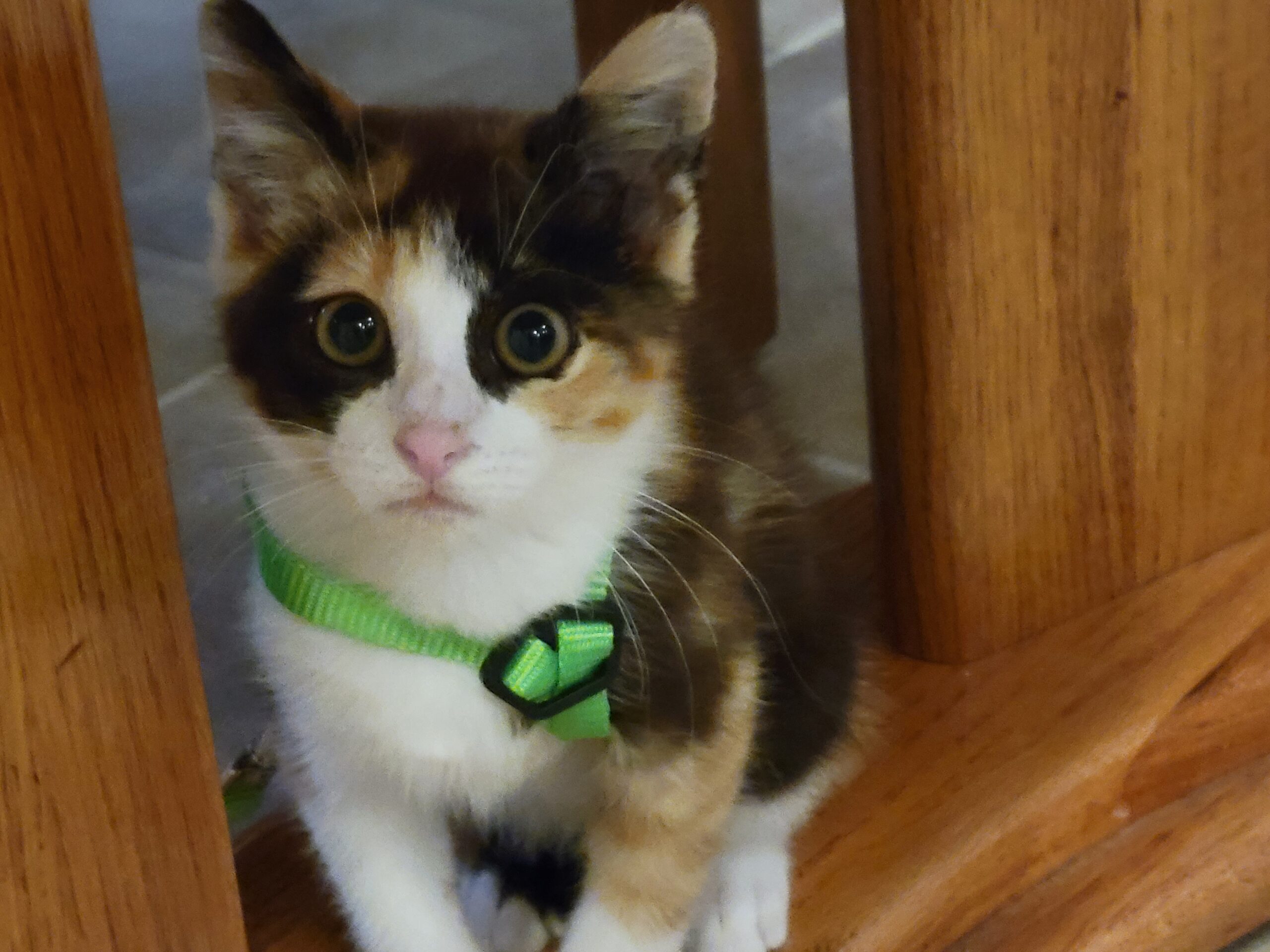
She arrived as a tiny, five-week-old rescue kitten, covered in fleas and severely anemic. A clerk at my husband’s veterinary office discovered the kitten crying on her doorstep, took her in, and fed her. Then she brought the kitten into the office. My husband sent me a picture of the tiny feline. We adopted her right away.
A Rescue Kitten


We failed to recognize the small feline’s lack of socialization with humans or other felines. She feared everything—her own shadow, sudden noises, even ordinary movements. We worried about her adjustment to us.
We named her Patches because of her calico markings. Since she had never learned normal cat behavior from other cats, she didn’t meow—she squeaked.
As a precaution to keep her from bolting in fear, we set up a cat playpen. Several times a day, I took her out to hand-feed her and slowly build trust. For exercise, we fitted her with a tiny harness and leash so she could cautiously explore the house like a nervous little tourist.


We named her Patches for her calico markings.
After a few months of bonding, we finally trusted that she wouldn’t run away. She proudly graduated from her playpen and began exploring the house on her own terms. The broom and vacuum cleaner still sent her sprinting for cover, though over time she learned the vacuum wasn’t a monster after all.
Patches still startles easily and is skittish, but she has come a long way from that frightened kitten covered in fleas. Love and attention transformed Patches from a fearful kitten to a confident cat. Now, wherever we are, she wants to be there, too. And despite her fearful beginnings, she has become one of the most affectionate cats we’ve ever owned. Plus, she is fun to watch her play.
A confident and affectionate cat

In some ways, I started a lot like Patches—fearful of unfamiliar people, unfamiliar places, and unfamiliar situations. Part of that fear stemmed from growing up with dyslexia. Reading was akin to assembling a puzzle with missing pieces. Letters looked jumbled and confusing, and sometimes the same word appeared differently every time I looked at it.
Fearful like Patches
School became a place where I often felt defeated and inadequate. Learning to read didn’t come easily for me. Check out more of my story with dyslexia.
Over time, though, I learned ways to compensate for my learning disability. Slowly, word by word and page by page, reading became less intimidating. More importantly, through prayer and Scripture reading, my fear gradually lessened.

I’ve progressed significantly, like Patches. I am still tested by unfamiliar settings, but they no longer dictate my life as they once did. God’s love and the promise that God is always with me transformed a fearful child into an adult who reaches out to others. I became a teacher, then a chaplain. I am a published author. Fear no longer controls me, and I am thankful for God’s love and promises.
God’s love and promises transformed me.

Fear is powerful. Fear can be from many things: people, disasters, illnesses, cancer, failure, scarcity, inadequacy. Often, the greatest fear comes from the unknown.
Fear is powerful.
Some anxiety can be healthy about new situations; it alerts us to danger, but intense fear can paralyze, as with Patches.
Assurance is given to us in Scripture. “Fear not” or “be not afraid” appears around 80 times in the Bible, making it a recurring theme.
“So do not fear, for I am with you;
Do not be dismayed, for I am your God.
I will strengthen you and help you;
I will uphold you with my righteous right hand,” (Isaiah 41:10).
Many well-known biblical figures grappled with fear, anxiety, and inadequacy, yet they often conquered those emotions through faith in God.
Examples include Gideon (fear of inadequacy), Elijah (fear and burnout), Moses (fear of failure), Peter (fear of danger and of people), and David (fear of enemies). Each biblical hero shows us that fear is a normal human emotion that didn’t prevent individuals from being used by God.
There is no condemnation
If you experience fear, anxiety and inadequacy you’re in good company. There is no condemnation. We can run to our loving God and hold on to the promise that God is with us.
Scriptures gives us a wonderful promise. “Be strong and courageous. Do not be afraid or terrified because of them, for the Lord your God goes with you; he will never leave you nor forsake you,” (Deuteronomy 31:6 NIV).
The biblical characters mentioned above stepped out in faith despite their fear. They took one step at a time, which demonstrated courage. Courage is not the absence of fear; it takes a step when one is afraid.
Courage is not the absence of fear.
Many well-known people have faced apprehension and distress. A famous quote from C.S. Lewis is “Courage is acting despite fear, not being fearless. It is the mastery of, or resistance to, fear, allowing individuals to act despite anxiety, worry, or danger. True courage involves recognizing that something else—a goal, value, or person—is more important than the fear itself.”
Another well-known person faced the unknown of a war. “Courage is not the absence of fear, but rather the assessment that something else is more important than fear” (Franklin D. Roosevelt).
The next time you are distressed in a situation or worried, hold on to God’s promises and take a courageous step.
Grace Offers Hope,

Check out Charleen’s book on Grief and Loss. Sixty devotions for healing and comfort.


Leave a Reply